
You can absolutely repurpose kitchen cabinets as bathroom vanities—I’ve seen homeowners save 30–50% doing this. Kitchen cabinets offer deeper countertops (24 inches) for nearly double the work surface and storage. The catch? You’ll need to adjust for height differences, cut openings for plumbing, and waterproof everything thoroughly. Mount them to wall studs, seal all wood surfaces, and choose moisture-resistant hardware. It’s straightforward if you plan ahead. There’s plenty more to know about making this work smoothly in your space.
Is It Possible? What You Need to Know
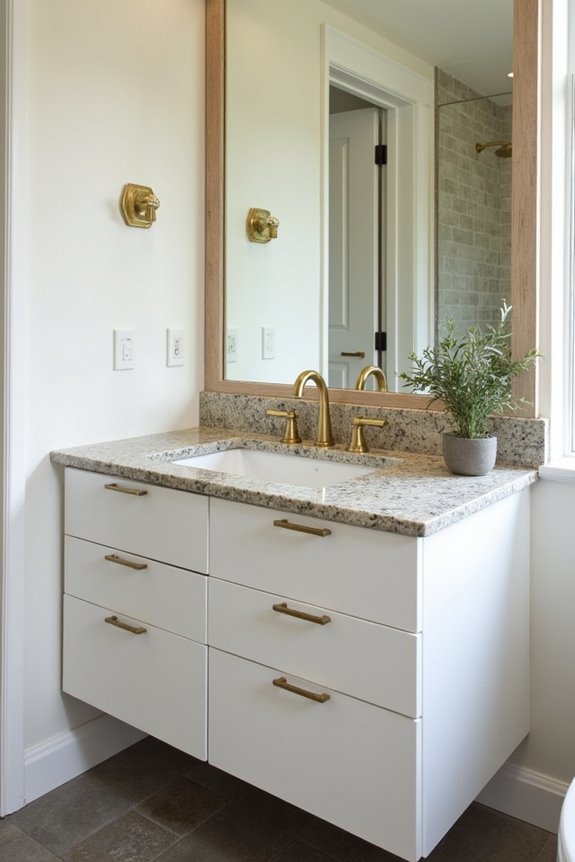
Why wouldn’t you be able to use kitchen cabinets in your bathroom? You absolutely can. I’m doing it, and many homeowners successfully repurpose kitchen cabinets for extra storage and counter space.
Kitchen cabinets work great in bathrooms. I’m using them myself, and many homeowners do too for extra storage.
Here’s what matters: kitchen cabinets are taller (34.5–35 inches) and deeper (24 inches) than bathroom standards (31 inches tall, 21 inches deep). You’ll need to adjust them to fit your space properly.
The bigger challenge? Moisture resistance. Bathrooms are humid environments, so you’ll need to seal materials carefully and reinforce your cabinets against water damage.
Consider your plumbing too. You might need cutouts for sinks, drains, and pipes. Planning ahead prevents expensive mistakes. With proper modifications, kitchen cabinets transform into functional bathroom storage that saves money and looks great.
Dimension, Material, and Design Gaps to Plan Around
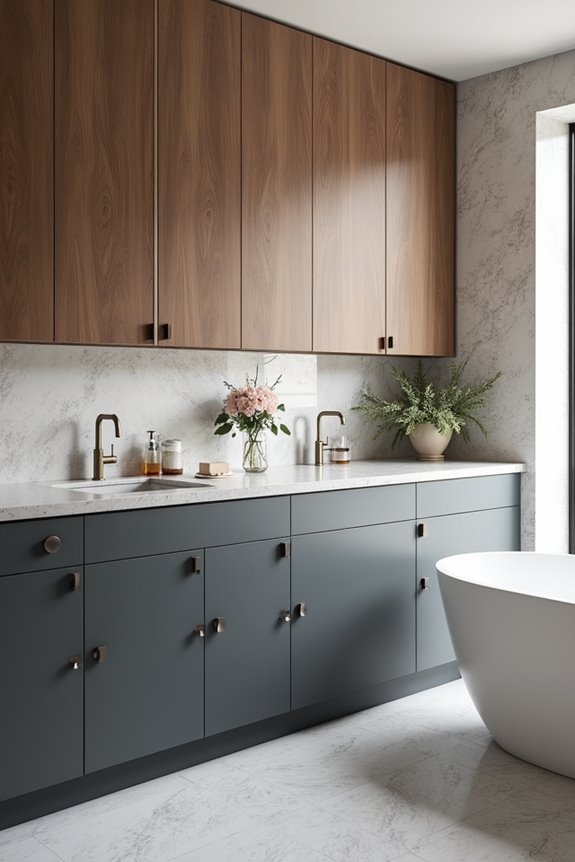
When you’re thinking about moving kitchen cabinets into your bathroom, you’ll run into some real obstacles that need your attention before you buy anything. Kitchen cabinets sit taller (around 34.5 inches) and deeper (about 24 inches) than bathroom vanities, so you might need to cut them down or adjust their placement to fit your space and plumbing lines. Beyond the sizing challenge, kitchen cabinet finishes aren’t built to handle bathroom moisture, which means you’ll need to seal or replace materials to prevent warping and damage from humidity.
Height And Depth Mismatches
kitchen cabinets and bathroom vanities just aren’t built to the same specs. The height and depth mismatch between these two cabinet types requires real planning before you install anything.
| Measurement | Kitchen Cabinet | Bathroom Vanity | Impact |
|---|---|---|---|
| Height | 34.5 inches | 31.5 inches | Countertop feels too high |
| Depth | 24 inches | 21 inches | Sink placement issues |
| Custom Height | N/A | 29–30 inches | More flexibility option |
| Floor Space | Standard | Tight | Drawer operation difficult |
| Plumbing Clearance | Generous | Limited | Modification necessary |
That three-inch height difference matters more than you’d think. Your sink won’t sit right, and your countertop might protrude awkwardly into the bathroom. The depth mismatch affects how drawers open and whether plumbing fits behind the cabinet. You’ll likely need modifications—shimming, cutting, or custom adjustments—to make kitchen cabinets work in your bathroom space.
Material Durability Considerations
Beyond fitting your kitchen cabinets into your bathroom’s tight dimensions, you’ve got to think about what’ll actually survive in there. Bathrooms are moisture-heavy spaces, and regular kitchen cabinets often can’t handle it. Here’s what matters:
- Moisture-resistant materials like plywood with waterproof sealant outperform solid wood
- Proper sealing of any natural hardwood prevents swelling and warping
- Waterproofing finishes create protective barriers against humidity
- Plywood cores resist moisture better than particleboard
- Hardware upgrades to stainless steel prevent rust
Retrofitting cabinets costs more when you add waterproofing treatments. You’re essentially rebuilding them for bathroom conditions. Without proper moisture exposure protection, your cabinets’ll deteriorate faster than they would in a kitchen. Plan on investing in quality sealants and finishes—it’s worth protecting your investment.
Cost Savings and Storage Advantages of Kitchen Cabinet Repurposing
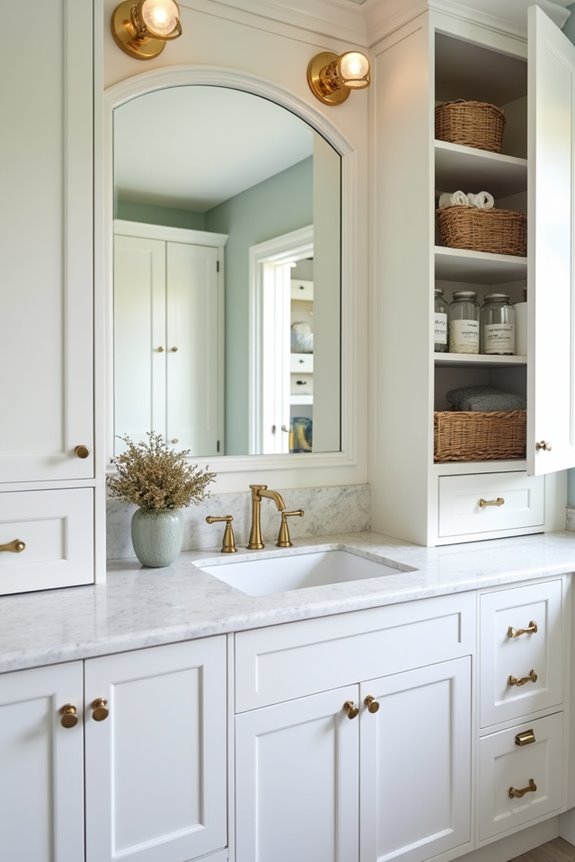
When you repurpose kitchen cabinets for your bathroom, you’re looking at real money savings—often spending 30-50% less than buying new bathroom vanities while gaining considerably more storage for toiletries, towels, and cleaning supplies. I’ve found that kitchen cabinets’ deeper 24-inch countertops give you almost double the work surface compared to standard bathroom vanities, which means more room to organize your daily essentials and reduce clutter. Plus, those extra drawers and shelving compartments inside kitchen cabinets let you maximize vertical space without eating up floor room, making even compact bathrooms feel more functional and less cramped.
Budget-Friendly Retrofit Solutions
Repurposing cabinets from your old kitchen makeover in the bathroom can save you thousands of dollars compared to buying custom bathroom vanities. Here’s why this budget-friendly retrofit makes sense:
- Kitchen cabinets cost significantly less than bathroom-specific vanities
- You’ll gain extra storage depth (typically 24 inches) for all your toiletries
- Larger countertops provide more surface space for daily essentials
- Installation uses standard tools you may already own
- Modifications like plumbing openings are straightforward DIY projects
When you choose this bathroom retrofit approach, you’re joining smart homeowners who’ve discovered practical solutions. The kitchen cabinets you’re considering already meet durability standards. With proper mounting and reinforcement, they’ll handle sink weight perfectly. Planning ahead—measuring your space and sketching plumbing locations—prevents costly mistakes. You’ll create a functional, personalized bathroom without breaking your budget.
Expanded Storage Capacity Benefits
Once you’ve settled on the budget savings, you’ll quickly discover that kitchen cabinets deliver something equally valuable: considerably more storage than standard bathroom vanities. Your repurposed kitchen cabinets storage dramatically outperforms typical bathroom options because they’re designed for deeper shelving—about 23 inches compared to 21 inches in traditional vanities. This extra depth transforms your bathroom storage capacity completely. You’ll fit larger towel stacks, oversized toiletry bottles, and cleaning supplies that’d never squeeze into standard spaces. The deeper shelves mean you’re not cramming everything into tight corners anymore. You gain genuine room to breathe, organize, and actually find what you need. That’s the real win with repurposed kitchen cabinets: you’re not just saving money, you’re fundamentally upgrading how much your bathroom can hold and how easily you can access it.
Enhanced Counter Space Utilization
How much counter space do you actually have right now in your bathroom?
I’ve discovered that kitchen cabinets transform your bathroom by offering substantially more countertop depth than standard vanities. Here’s what makes the difference:
- Kitchen cabinets provide 24 inches of depth versus typical vanity depths of 17–24 inches
- You’ll gain extra surface area for daily essentials like toothbrushes, skincare products, and decorative items
- Additional countertop space reduces clutter and creates a more organized feel
- More room means you’re not constantly shuffling items around
- Your bathroom storage becomes functional and visually appealing
This enhanced counter space utilization addresses a real problem most bathrooms face. When you repurpose kitchen cabinets, you’re not just getting bathroom storage—you’re creating a practical workspace that handles your actual daily needs. The extra inches matter more than you’d think.
Measure Your Bathroom Space
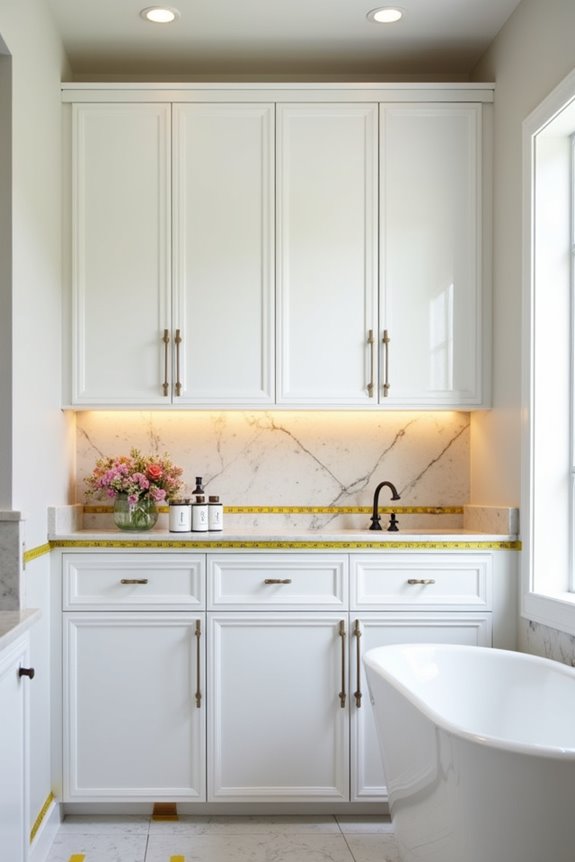
Before you haul those kitchen cabinets into your bathroom, you’ll need to understand the space you’re actually working with. I recommend measuring your wall width at three points: the baseboard, halfway up, and near the ceiling. This catches any irregularities that might surprise you later.
Next, check your ceiling height and note any soffits that could interfere with cabinet placement. Document your depth carefully—bathrooms typically need less depth than kitchens, so verify you’ve got enough room for your vanity configuration.
Consider whether you’re installing a single-sink vanity (24–36 inches) or double vanity (48–60+ inches). Mark your door, window, and electrical outlet locations too. This groundwork prevents costly mistakes and ensures your kitchen cabinets fit perfectly in your new bathroom space.
Will Your Cabinets Fit?
The real question isn’t whether you can squeeze kitchen cabinets into your bathroom—it’s whether they’ll work without creating headaches down the road.
Kitchen cabinets are typically 34.5 inches tall and 24 inches deep. Your bathroom likely needs something shorter and shallower. Here’s what I’d check:
- Cabinet dimensions: Measure your kitchen cabinet height against your bathroom wall space
- Depth mismatch: Kitchen cabinets extend 24 inches; bathroom vanities average 17–24 inches
- Fit under sink: You’ll need clearance for plumbing and pipes beneath the counter
- Door swing: Verify cabinet doors open without hitting walls or fixtures
- Counter height: Standard bathroom height sits at 31 inches, while kitchen cabinets reach 34.5 inches
A depth mismatch means your cabinet might protrude awkwardly. You might need to adjust or trim the back. That’s doable, but it requires planning beforehand so you’re not caught off guard during installation.
Plan Plumbing Access and Sink Installation
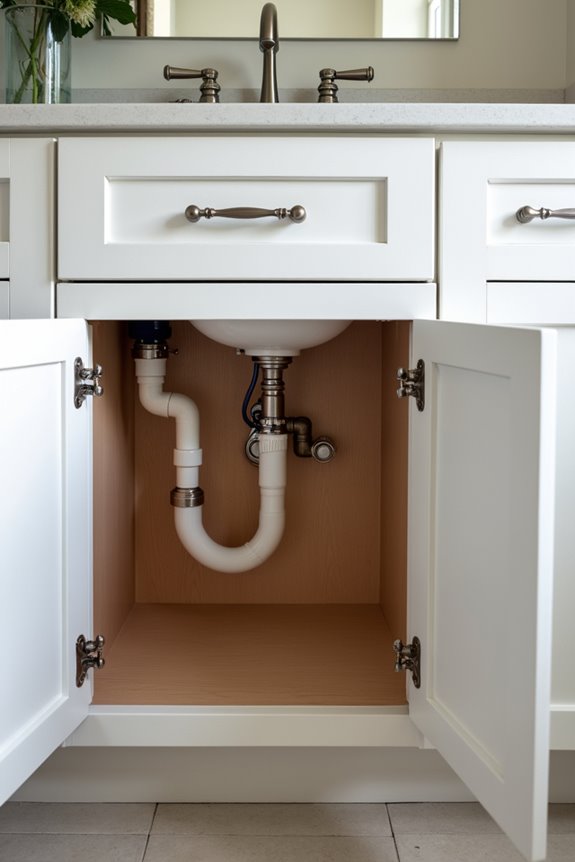
Once you’ve confirmed your cabinet will physically fit in your bathroom, you’ve got to tackle plumbing—and that’s where kitchen cabinets need real adjustments.
I’ll help you navigate cabinet modification for proper plumbing access and sink installation. You’ll need to remove conflicting drawers and cut openings in the cabinet floor and back panel. Here’s what I recommend tackling:
| Task | Why It Matters | Your Action |
|---|---|---|
| Remove drawers | Creates drain space | Take out interfering drawers first |
| Cut openings | Accommodates pipes | Cut floor and back panel carefully |
| Trim base back | Allows shallower fit | Trim about 2⅛ inches if needed |
| Route pipes | Saves space | Plan configurations before cutting |
After modifications, reattach drawer faces to maintain your cabinet’s finished look. Reinforce interiors to preserve drawer functionality. This approach keeps your bathroom cabinet both practical and attractive while ensuring proper plumbing connections.
Kitchen Cabinet Mistakes to Avoid
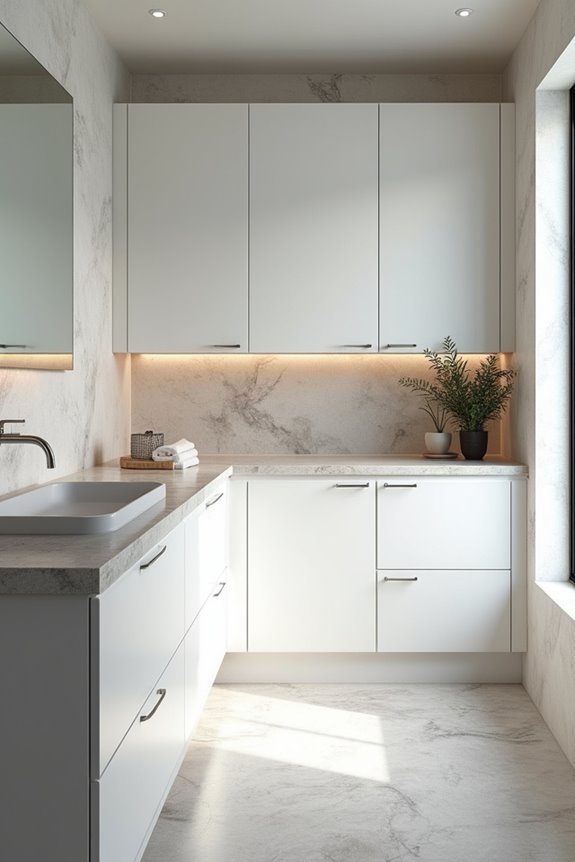
When you’re converting kitchen cabinets for bathroom use, I’ve learned that there are three major mistakes you’ll want to dodge right from the start. First, ignoring your plumbing needs—like where pipes’ll go and how you’ll fit a sink—can turn your project into a costly nightmare, so map out every detail before you buy anything. Second, forgetting about moisture protection leaves your cabinets vulnerable to warping and mold, and third, misjudging the size difference between kitchen and bathroom standards means your new vanity might tower over the space or sit awkwardly low.
Ignoring Plumbing Requirements
How often do folks forget that kitchen cabinets weren’t designed with bathroom plumbing in mind? I’ve seen this mistake derail projects before, and I want to help you avoid it.
Kitchen cabinets lack the cutouts and space for pipes, drains, and fittings that bathroom vanities have. Here’s what you need to consider:
- Plan plumbing routes before installation
- Account for depth differences (kitchen cabinets run 23–24 inches; bathroom needs are 21 inches)
- Ensure moisture resistance through proper sealing
- Budget for plumbing retrofit work
- Verify height compatibility with your sink setup
Ignoring these requirements creates costly headaches. You’ll face water damage, mold, and structural problems. Taking time upfront to address plumbing needs protects your investment and keeps your bathroom functioning properly long-term.
Overlooking Moisture Protection
You’d be surprised how many bathroom cabinet projects fail because folks underestimate water’s relentless nature. I’ve seen it happen: someone installs kitchen cabinets without proper moisture protection, and within months, swelling and warping begin.
Here’s the thing—bathrooms aren’t like kitchens. The constant humidity demands serious moisture resistance. Natural hardwood needs protective sealing or veneer coating to survive bathroom conditions. Without it, water seeps into seams and joints, causing irreversible damage.
I recommend inspecting every seam carefully and applying waterproof sealant around edges where moisture loves to hide. Your bathroom cabinetry investment depends on this step. Don’t skip the moisture-protective finish either—it’s your cabinet’s best defense against humidity’s slow destruction. Trust me, prevention beats replacement.
Misjudging Size And Scale
Now that you’ve sealed those seams against moisture, there’s another common pitfall that can derail your bathroom cabinet project: getting the dimensions wrong.
Kitchen cabinets aren’t built for bathroom spaces. Here’s why size and scale matter:
- Kitchen cabinets typically measure 24 inches deep and 34 inches tall
- Bathroom cabinets stay shallower at 21 inches deep and 31.5 inches tall
- Oversized kitchen cabinets overwhelm smaller bathrooms
- Mismatched proportions create an awkward, cramped feeling
- Deeper cabinets block sink accessibility and movement
Your bathroom storage shouldn’t dominate the room. When you choose kitchen cabinets, you’re introducing bulk that visually shrinks your space. I’ve seen projects where this single mistake made bathrooms feel claustrophobic.
Stick with bathroom-scaled cabinetry. Your space—and your daily routine—will thank you.
Strengthen Your Cabinets for Sink Weight
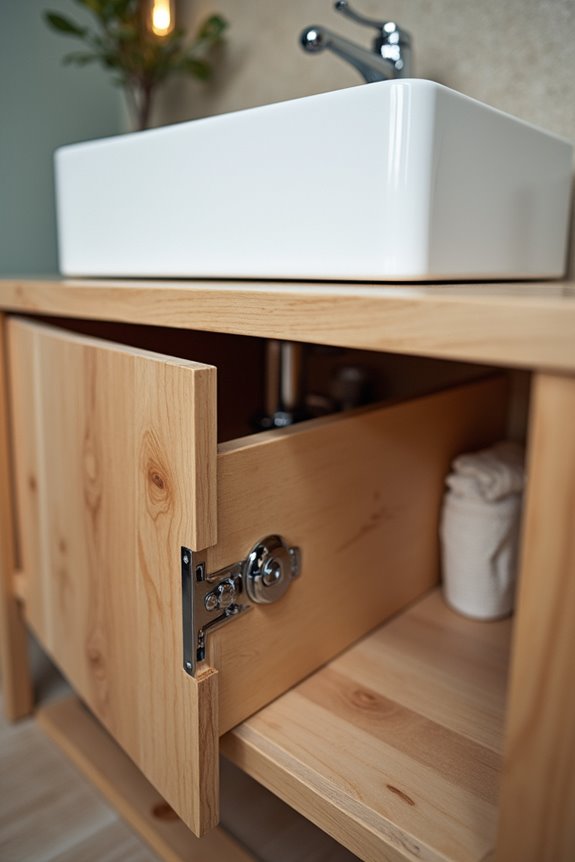
When you’re converting kitchen cabinets into bathroom vanities, the weight of a sink—especially a heavy ceramic or stone model—demands serious reinforcement. I’ve learned that attached cabinets need proper support to handle this weight-bearing responsibility.
Here’s what I recommend for strengthening your setup:
| Reinforcement Method | Material | Purpose | Installation | Benefit |
|---|---|---|---|---|
| Wall Studs | Wood framing | Core anchoring | Locate and attach directly | Maximum stability |
| Sub-frame | 3-inch wood screws | Weight distribution | Build beneath sink | Prevents failure |
| Stretcher Brace | Horizontal support | Extra reinforcement | Connect cabinet sides | Added security |
| Particleboard Bracing | Additional wood | Cabinet reinforcement | Inside cabinet | Supports plumbing |
| Cabinet Backing | Solid panel | Foundation support | Entire cabinet depth | Professional result |
Don’t skip these steps. Your bathroom cabinets will thank you, and so will your fixtures. You’ve got this!
Waterproofing and Moisture-Resistant Finishes
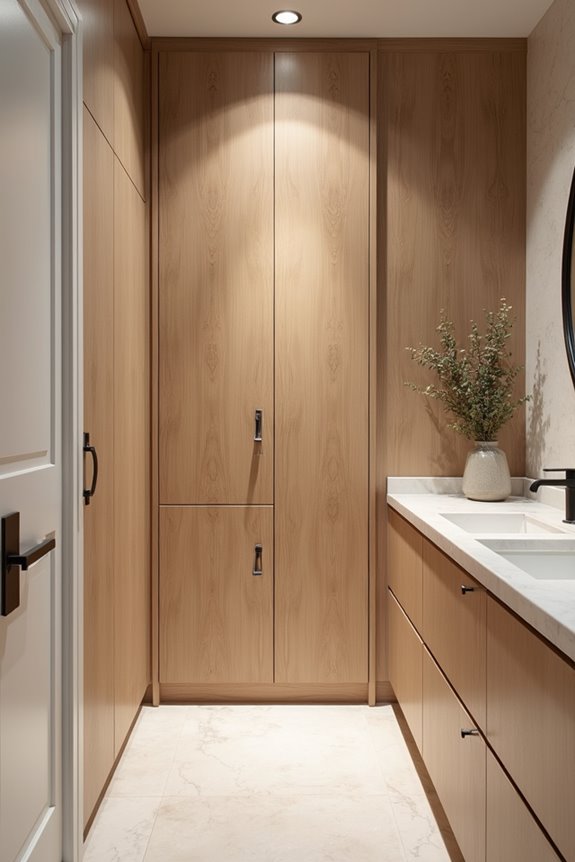
When you’re adapting kitchen cabinets for your bathroom, you’ll need to treat them with moisture-resistant finishes and protective sealants—think of it like giving your cabinets a waterproof shield against all that humidity and splashing. I’d recommend applying a high-quality polyurethane or marine-grade sealant to all exposed wood surfaces, paying special attention to seams, joints, and the cabinet bottom where water loves to hide. You’re not just protecting the wood itself; you’re also preventing swelling, warping, and that musty smell that comes when moisture sneaks into untreated areas.
Moisture Resistance Requirements
Because bathrooms are essentially water zones, you’ve got to think seriously about moisture resistance if you’re planning to use kitchen cabinets in there.
Here’s what I’d focus on for bathroom cabinetry:
- Sealed surfaces – Apply waterproof finishes to all exposed wood
- Veneer coating – Natural hardwood needs protective veneer layers
- Quality cabinet finishes – Choose moisture-resistant paints and polyurethane
- Seam protection – Seal edges where water sneaks in
- Regular maintenance – Reseal annually to keep protection strong
Kitchen cabinets aren’t naturally built for bathroom humidity, so you’ll need to upgrade them. I recommend treating your cabinet finishes like a shield against water damage. Without proper sealing, moisture creeps into wood and causes warping, swelling, and rot. You’re essentially creating a moisture-resistant barrier that keeps your investment safe and looking great for years.
Protective Sealant Application
How do you actually protect kitchen cabinets so they survive bathroom moisture? You’ll need to apply protective sealants that create a waterproofing barrier against humidity and water exposure. I recommend starting with a high-quality polyurethane finish, which provides excellent moisture protection for wood surfaces. Apply at least two coats, letting each dry completely between applications. Pay special attention to seams and edges where water sneaks in. Next, seal any exposed wood with a water-resistant primer before finishing. For extra protection, consider adding a semi-gloss or gloss finish rather than flat, since these repel water better. Don’t skip the cabinet’s interior surfaces either. Regular inspection helps catch damage early. This approach transforms kitchen cabinets into bathroom-ready furniture that’ll last for years.
Make Room for Pipes and Drains Inside
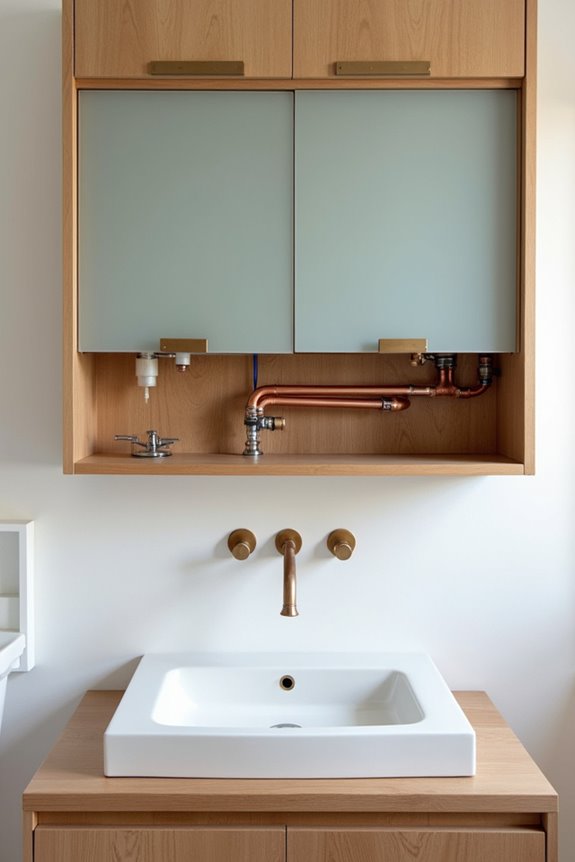
One of the trickiest parts of converting kitchen cabinets to bathroom use involves dealing with plumbing that wasn’t part of the original design. You’ll need to get creative with space to make your bathroom storage work around pipes and drains.
Here’s what I’d tackle:
- Remove conflicting drawers that block sink plumbing
- Cut the cabinet floor and back panel for pipe routing
- Back-cut the base by about 2⅛ inches for clearance
- Route plumbing strategically to keep storage accessible
- Glue drawer faces back on if you want that finished look
These adjustments let you maximize your kitchen cabinets as functional bathroom storage. The work’s straightforward once you map out where everything goes. You’ve got this.
Choose Hardware That Matches Your Bathroom Style
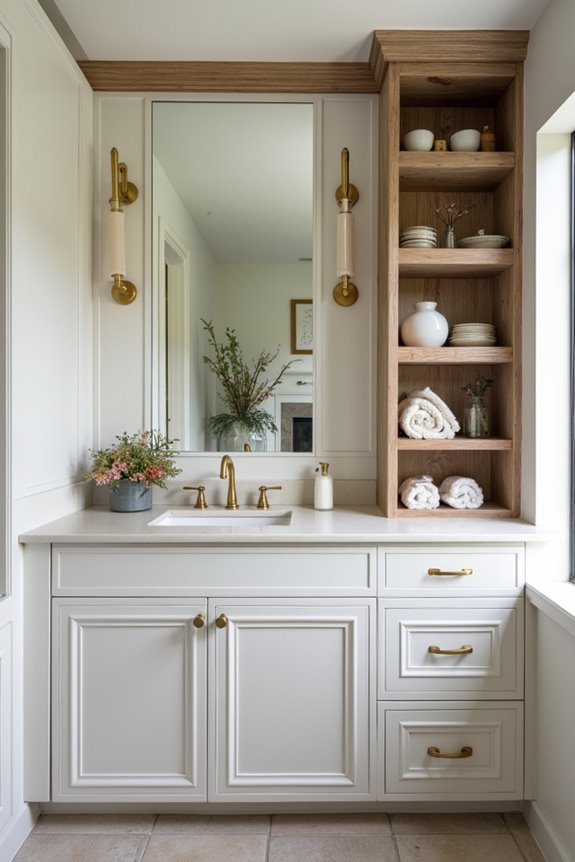
After you’ve sorted out the plumbing and got your cabinet functioning properly, it’s time to make it look like it actually belongs in your bathroom.
Your hardware finishes are crucial here. I’d recommend choosing chrome, nickel, or stainless steel to echo your existing bathroom elements. These metals create a cohesive design that ties everything together beautifully.
Here’s what matters: match your cabinet knobs and pulls to other fixtures in the room—your faucet, towel bars, and light fixtures. This repetition of metal tones makes your kitchen-cabinet-inspired vanity feel intentional, not random.
Size matters too. Pulls should be roughly one-third your drawer’s width for balanced proportions.
Want contrast instead? That works. Just commit to it deliberately. The key is making a choice that reflects your bathroom style, not leaving it to chance.
Mount Cabinets to Wall Studs
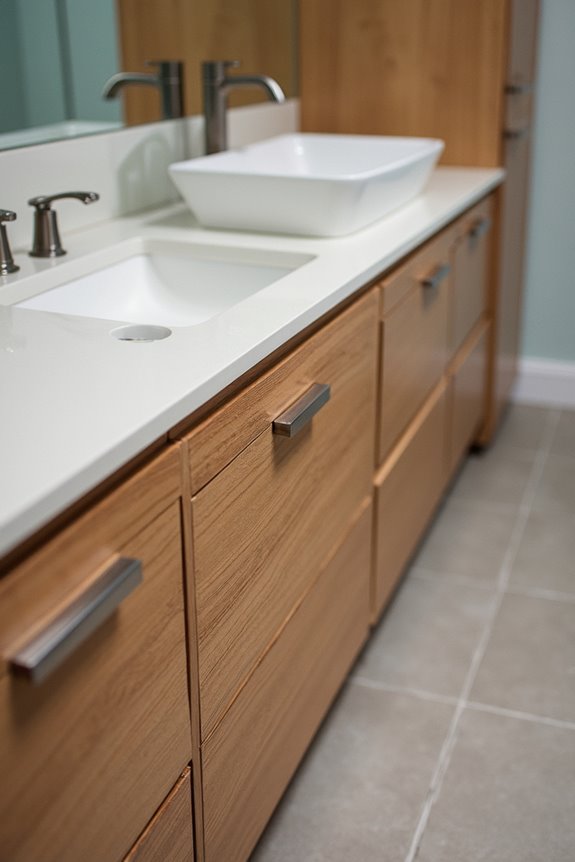
Securing your kitchen cabinet to wall studs is the foundation of a safe, long-lasting bathroom vanity. I’ll walk you through why this matters and how to do it right.
Securing your kitchen cabinet to wall studs is the foundation of a safe, long-lasting bathroom vanity installation.
Here’s what you need to focus on:
- Locate studs using a stud finder before mounting your bathroom cabinetry
- Mark stud locations clearly with pencil for accurate fastening
- Use heavy-duty screws that penetrate at least 1.5 inches into studs
- Check that your cabinet sits level and plumb before final fastening
- Avoid relying solely on drywall anchors, which won’t support moisture and weight
The bathroom environment is tough on cabinetry. Moisture and daily use create stress that drywall alone can’t handle. Wall studs provide the solid foundation you need. This simple step ensures your investment stays secure for years.
Countertop Selection for Water Resistance and Durability
Your countertop choice makes or breaks your bathroom vanity’s longevity because it’s constantly exposed to moisture, splashes, and humidity. I’d recommend granite or marble—they’re natural stone countertop materials that resist water beautifully. Here’s what matters: sealed surfaces prevent damage. You’ll want to apply a quality sealant annually for maximum water protection.
Consider these options:
- Granite or marble: Naturally durable, sealed properly
- Engineered quartz: Nonporous, low-maintenance moisture resistance
- Sealed wood veneer: Works if properly treated
Avoid unsealed wood—it warps easily in bathrooms. Your moisture resistance depends entirely on that sealant layer. Think of it as your vanity’s shield against humidity and daily splashing. When you invest in proper countertop materials and maintain them, you’re protecting your entire cabinet investment. That’s smart planning.
Organize Repurposed Cabinets for Bathroom Storage
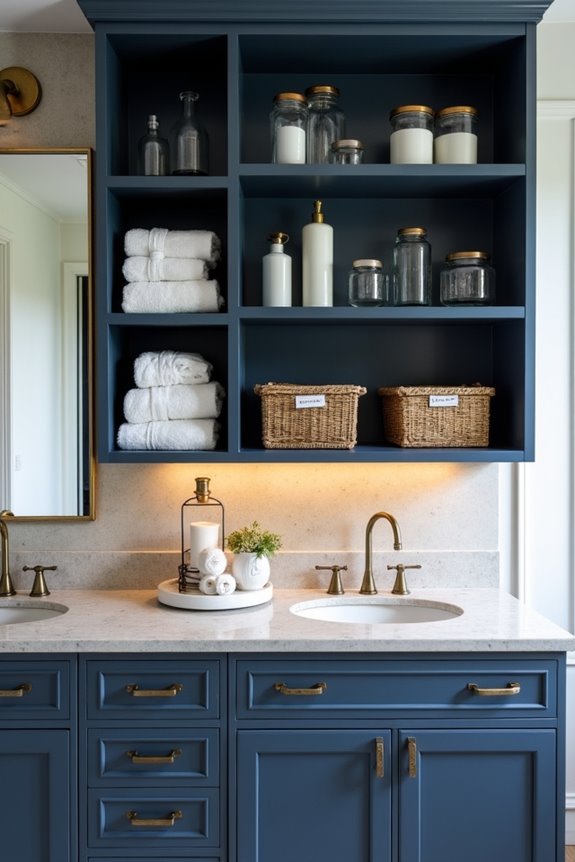
How do you fit a kitchen cabinet into a bathroom without creating a cluttered mess? I’ve found that smart organization transforms repurposing kitchen cabinets into functional bathroom storage. Here’s what I do:
- Remove unnecessary drawers to create open shelving for towels and frequently used items
- Install pull-out baskets inside deeper cabinets to access toiletries easily without reaching far back
- Label everything clearly so family members know where products belong
- Use moisture-resistant finishes like waterproof liners to protect contents from humidity damage
- Group similar items together—skincare products in one section, cleaning supplies in another
I keep my most-used items at eye level and store seasonal products higher up. This approach prevents clutter while maximizing your bathroom storage. You’ll appreciate having everything organized and protected from bathroom moisture.