
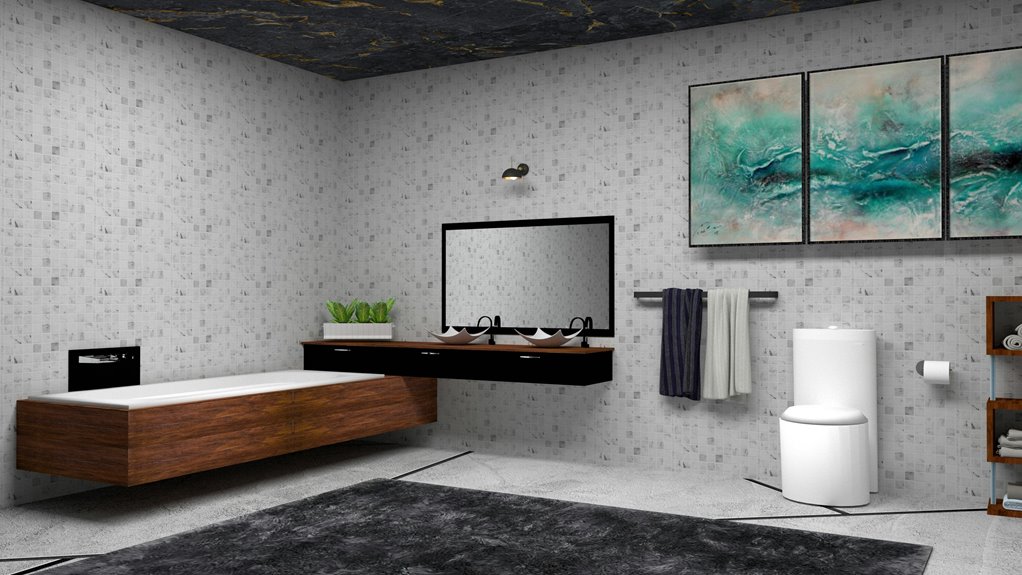
You’ll want moisture-resistant paint with mold inhibitors—not standard ceiling paint. I’d recommend Benjamin Moore Aura Bath & Spa or Sherwin-Williams Duration Home in satin or semi-gloss finish. The key? Use a mold-killing primer like Zinsser Perma-White first, then apply two thin coats. Run your exhaust fan during and after painting. Skip flat finishes and “paint & primer in one” products—they won’t cut it in steamy bathrooms. There’s more strategy to getting this right the first time.
Why Bathroom Ceilings Fail: How Steam Destroys Paint
Ever wonder why your bathroom ceiling paint peels and bubbles while the rest of your home stays fine?
Why does your bathroom ceiling paint peel and bubble while the rest of your home stays pristine?
Here’s what happens: steam rises from your shower and condenses on the cooler ceiling. This moisture seeps into regular paint, weakening its adhesion to the surface. The paint bubbles, cracks, then peels away in frustrating chunks.
Standard interior paints lack true moisture-resistance. They weren’t designed for steamy environments. Poor ventilation makes it worse, trapping humidity that accelerates damage. Without proper protection, mildew thrives on damp surfaces, creating dark spots that spread.
You need paint formulated specifically for bathrooms. Look for coatings with anti-mildew additives and proven adhesion properties. These specialized formulas resist moisture penetration, keeping your ceiling protected longer. It’s not just about appearance—it’s about preventing costly damage before it starts.
What Makes Paint Work in Steamy Bathrooms
When moisture-laden steam rises and hits your cooler ceiling, it doesn’t just sit there—it soaks into paint that isn’t built to handle it, breaking down the film layer and causing adhesion to fail. I’ve found that paints formulated to resist moisture actually create a tighter barrier, so water can’t penetrate as easily and weaken the bond between paint and surface. The trick is choosing a finish with enough sheen (satin or semi-gloss work best) and mold-fighting additives that actively fight back against the damp conditions your bathroom throws at them.
Moisture Penetration and Film Failure
Why does bathroom ceiling paint peel and bubble when other rooms stay fine? The answer lies in moisture penetration and film failure. When steam rises in your bathroom, it condenses on your cooler ceiling, forcing water directly into the paint film. Here’s the problem: most interior latex paints lack true moisture-blocking agents, so humidity cycles gradually weaken adhesion. Flat finishes are especially vulnerable—they’re porous and invite mildew growth faster than glossy options. Without proper ventilation, moisture accelerates beneath the coating, causing blistering and peeling. Your paint needs two jobs: seal against moisture and stay stuck under humidity stress. When either fails, you’re looking at failure. That’s why moisture-resistant, mildew-resistant ceiling paint with genuine moisture-blocking technology matters. It’s your best defense.
Steam Condensation and Adhesion Loss
Your bathroom ceiling’s biggest enemy isn’t dirt or age—it’s the invisible moisture cycle that repeats every time you shower. When steam rises, it condenses on your cooler ceiling, creating a relentless wet layer that weakens paint adhesion. Standard latex paints can’t handle this punishment because they lack moisture resistance agents.
| What Happens | Why It Matters | What You Feel |
|---|---|---|
| Paint bubbles and blisters | Moisture gets trapped between coats | Frustrated by peeling paint |
| Mildew spots appear | Poor adhesion allows water penetration | Embarrassed by black streaks |
| Paint cracks and flakes | Humidity cycles stress the film | Defeated by repeat failures |
| Ceiling looks worn fast | Weak paint bonds fail quickly | Angry at wasted money |
You need bathroom-specific paints with mildew inhibitors and superior adhesion formulas. They’re not optional—they’re essential for keeping your ceiling looking fresh and stopping moisture damage before it starts.
Why That “Bathroom-Safe” Label Is Often Misleading
I’ve noticed that manufacturers slap “bathroom-safe” on paint labels to make sales, but that tag doesn’t actually tell you what you’re getting—it’s more marketing than a real guarantee of moisture protection. What the label *should* say is whether the paint has mildewcides (mold-fighting chemicals), hydrophobic properties (water-repelling tech), and vapor resistance, but instead you’ll just see vague promises about being “washable” or “low-odor.” Here’s the reality: a standard latex ceiling paint with a “bathroom-safe” sticker won’t stand up to daily steam and condensation the way a genuinely specialized bathroom formula will, because true durability comes from the paint’s actual chemistry, not its marketing claims.
Marketing Claims vs. Reality
Ever notice how almost every paint can at the hardware store seems to promise it’ll handle your bathroom? I’ve learned the hard way that “bathroom-safe” labels don’t always deliver. Many so-called bathroom-safe paints lack real mold inhibitors and moisture resistance needed for steamy ceilings. Here’s what I discovered: generic ceiling paints fail because they don’t block moisture vapor effectively. The secret? You need primer compatibility with mildewcide-containing primers before applying your topcoat. Think of it like building a fortress—the primer’s your foundation. Without it, moisture sneaks underneath and causes mildew and blistering. Premium products like Aura Bath & Spa perform better than budget options, but only when paired with proper ventilation and surface prep. Don’t let marketing fool you. Real protection requires strategic layering.
What “Bathroom-Safe” Actually Means
How much can you really trust that “bathroom-safe” label on a paint can? I’ll be honest—not much. That label isn’t standardized, so manufacturers use it loosely without proving actual moisture-resistant or mildew resistance performance.
What actually matters? Three things. First, check for mold inhibitors in the formula—these actively fight bathroom growth. Second, verify moisture-resistant ratings; many “bathroom” paints still use basic latex that bubbles under steam. Third, ensure proper surface prep and ventilation work together with quality paint.
Premium bathroom paints include advanced polymers designed for humidity cycles. Budget labels often skip these essentials. Before buying, read the fine print. Look beyond marketing language. Ask yourself: Does it mention mold inhibitors specifically? Does it promise vapor resistance? If the answers are unclear, keep looking. You deserve a ceiling that actually lasts.
Types of Paints to Avoid (Even if Marketed for Ceilings)

Just because a paint label says “ceiling paint” doesn’t mean it’ll work in your bathroom—and that’s where many homeowners run into trouble. I’ve seen people grab standard flat ceiling paints only to watch them blister and peel within months. Here’s what to skip:
Standard flat ceiling paints. They’re too porous for bathroom humidity and fail quickly.
“Paint & primer in one” products. They lack true mold inhibitors and moisture resistance you need.
Interior flat paints labeled for dry areas. These have zero mildew-resistant qualities and won’t handle daily condensation.
Oil-based ceiling paints. While they offer moisture resistance, they yellow over time and release high VOCs.
The takeaway? Don’t trust labels alone. You need paints specifically formulated with mildew resistance and durability for steamy environments.
Best Bathroom Ceiling Paints for 2025
What’s the difference between a bathroom ceiling that holds up for years and one that peels apart in months? The paint you choose.
I’ve found that Aura Bath & Spa by Benjamin Moore stands out as the best all-around option. Its mold resistance and Color Lock technology mean your ceiling stays protected against moisture damage. If you want a self-priming solution, Zinsser Perma-White offers mildew resistance and changes from pink to white as it dries—handy for coverage checks.
For budget-conscious folks, Behr Premium Plus Ultra works decently with mold resistance, though priming helps. Sherwin-Williams Duration Home and Emerald lines bring professional-grade protection with antimicrobial features.
The real winner? Aura Bath & Spa delivers everything in one can. You get superior moisture protection without extra steps.
Bathroom Ceiling Finish: Matte or Semi-Gloss?
Once you’ve picked your paint, the next decision is just as important: what finish should you use? I’d recommend bathroom matte for steamy bathrooms because it resists glare and hides imperfections beautifully. Here’s what matters most:
- Matte finishes offer moisture resistance comparable to satin when formulated specifically for bathrooms with mold resistance built in
- Semi-gloss provides superior moisture resistance and easier cleaning, though it highlights surface flaws under artificial light
- Eggshell balances cleanability with a smoother appearance, making it ideal for ceilings
Modern bathroom matte paints are versatile. Pair them with mold-resistant primers like Zinsser Perma-White, and you’re creating a durable, washable ceiling that handles humidity like a champ. Your bathroom deserves protection without sacrificing comfort.
Why Mold-Killing Primer Is Required
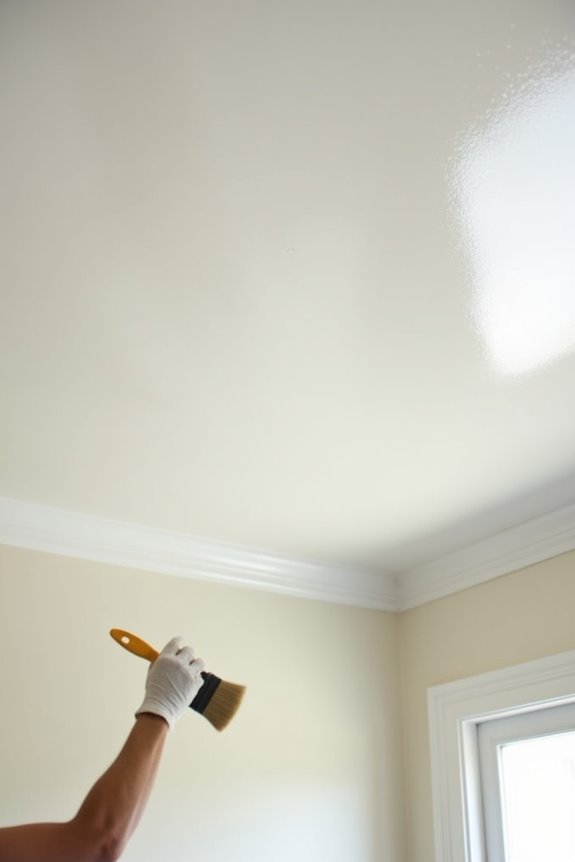
I’m going to walk you through why skipping mold-killing primer is a costly mistake, because moisture will trap behind regular paint and create hidden mold growth that ruins your ceiling from underneath. Without a mildewcide primer, water vapor seeps into the paint layer, feeds mold spores, and eventually causes your topcoat to bubble and peel—forcing you to redo the whole job. A quality mold-killing primer stops this before it starts by encapsulating any existing mildew and creating a moisture-resistant barrier that keeps your bathroom ceiling protected for years.
Moisture Trapping Behind Paint
they’re basically moisture magnets. Steam rises, condenses on cooler surfaces, and gets trapped behind your paint film. Without the right primer, that trapped moisture creates the perfect mold breeding ground.
I’ve seen what happens when homeowners skip mold-killing primer:
- Paint bubbles and peels because moisture pushes from underneath
- Mildew grows invisibly behind the film, spreading unseen
- Structural damage occurs as water degrades the ceiling material
A mildewcide-containing primer encapsulates existing mold and creates a moisture-blocking barrier. This means your bathroom ceiling stays protected, not just painted. Think of it as armor against humidity rather than a cosmetic fix. Your primer does the heavy lifting so your topcoat can focus on looking great long-term.
Mold Growth Under Topcoat
When you paint over mildew without treating it first, you’re fundamentally trapping the problem under a fresh coat of paint—and that’s where things get worse. The mold continues growing beneath your bathroom ceiling paint, eventually breaking through or spreading sideways. That’s why I recommend using a mold-resistant primer specifically designed for bathrooms. These primers contain mildewcides that actively kill existing mold spores and encapsulate them. Before priming, clean affected areas thoroughly with bleach and water, then dry completely. A quality mildew-resistant primer creates a moisture barrier that prevents future mold from taking hold under your topcoat. In humid bathrooms, this extra protection isn’t optional—it’s essential. You’re investing in a ceiling that stays fresh longer.
Adhesion Failure Prevention
Paint peeling and flaking off your bathroom ceiling usually points to one culprit: mold lurking beneath the surface. I’ll show you how a mold-killing primer prevents this frustrating adhesion failure.
When moisture seeps behind paint, mold grows invisibly. Your topcoat loses grip and fails. That’s where mildew-resistant primer steps in. Here’s what makes it essential:
- Encapsulation: Mold-killing primer traps existing mold spores, stopping their spread
- Moisture resistance: It blocks water from penetrating and feeding new mold growth
- Strong bonding: Better adhesion means your bathroom paint stays put longer
For your bathroom paint project, skip generic primers. Choose one labeled “bathroom” or “kitchen.” Clean any visible mildew with bleach-water first, then apply your mold-killing primer. You’re building a moisture-resistant barrier that keeps paint adhered and mold defeated. Trust this approach—it works.
Prepping a Bathroom Ceiling for Paint Success
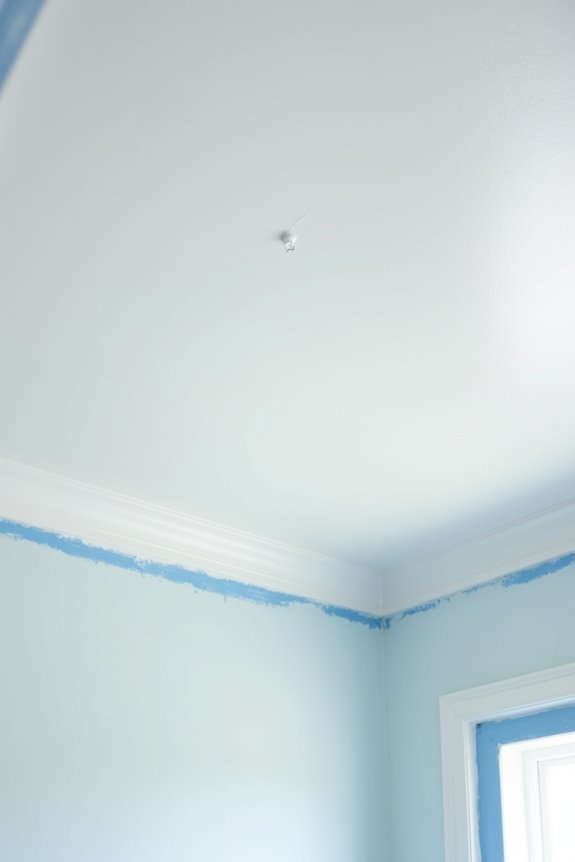
How ready is your ceiling for a fresh coat of paint? I’m glad you’re taking this seriously. Here’s what you need to do first.
Start by thoroughly cleaning away dirt, grease, and mildew with a good scrubbing. Next, repair any cracks or holes, then sand the surface smooth. This creates the foundation for success.
Thoroughly clean dirt and mildew, repair cracks and holes, then sand smooth. This foundation ensures painting success.
Before painting, apply a mold-resistant primer. It’ll improve adhesion and block stains—two things you definitely want in a bathroom. Let it cure completely, about 24 hours.
Check that your ceiling is completely dry and moisture-free. No damp spots allowed. Run your exhaust fan during prep work and painting to control humidity.
Proper drying time matters. You’re investing in a finish that’ll last, so don’t rush this step. You’ve got this.
Low Ceilings Over Showers
Your bathroom ceiling over the shower faces unique challenges—it’s ground zero for moisture and steam. I recommend prioritizing mildew-resistant bathroom paints with a moisture-tolerant finish that stands up to constant humidity.
Here’s what I’ve found works best:
- Apply a mold-killing primer first over any patched areas to create a solid, protective base
- Choose satin or semi-gloss finishes instead of flat paint—they resist condensation far better
- Apply two thin coats rather than one heavy coat to prevent bubbling and improve adhesion
Run your vent fan during and after showers to minimize steam exposure that can damage your topcoat. I’d also suggest considering water-repellent mattes like Aura Bath & Spa—they balance glare reduction with serious moisture protection. You’ve got this.
No Ventilation? Here’s What Works
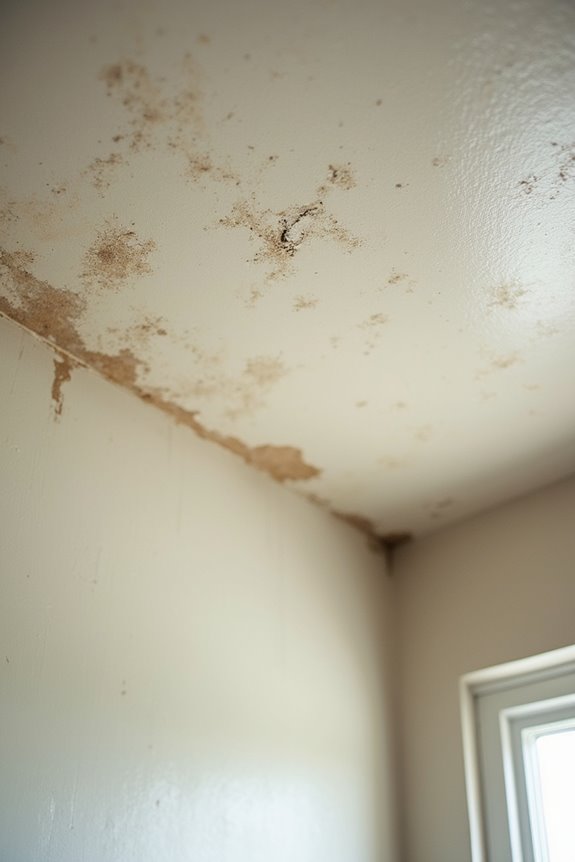
If you’re dealing with a bathroom ceiling that lacks proper ventilation, I’ve got two game-changing strategies that’ll help you win the mold battle: start with a mold-killing primer like Zinsser over a completely dry surface, then top it with premium bathroom paint formulated with mildew inhibitors such as Aura Bath & Spa or Perma-White. These specialized products work together to create a moisture-fighting shield that standard ceiling paints simply can’t match. Before you paint though, tackle any existing leaks and consider upgrading your exhaust ventilation, because even the best paint needs your help to truly last.
Primer-First Mold Defense
When bathrooms lack proper ventilation, moisture gets trapped and mold thrives—but you can stop it before it spreads. I’ll walk you through a primer-first mold defense strategy that protects your bathroom ceiling.
Here’s your action plan:
- Clean first. Remove existing mildew with bleach-and-water solution while wearing gloves and a mask. Ventilate thoroughly, then let surfaces dry completely.
- Choose wisely. Select a mildew-resistant primer like Zinsser Mold Killing Primer or Kilz. These encapsulate existing mold and prevent future growth.
- Wait patiently. Allow primer to dry for 24 hours before applying topcoat. This ensures proper sealing and adhesion.
This primer-first approach gives your bathroom ceiling real protection. You’re not just painting over problems—you’re building a lasting defense against moisture damage that keeps your space safe and fresh.
Maximum Moisture Resistance Paint
Now that you’ve got your mold-killing primer in place, it’s time to choose a topcoat that won’t let moisture win. I’d recommend bathroom-paint formulas specifically designed with mildew inhibitors and hydrophobic properties. Brands like Zinsser Perma-White Mold & Mildew-Proof or Benjamin Moore Aura Bath & Spa excel at humidity resistance in poorly ventilated spaces.
Skip flat finishes. Instead, go with semi-gloss or satin—they shed water better and wipe clean easily. These moisture-resistant options create a protective barrier against condensation buildup.
For maximum protection, consider self-priming systems that work in one coat. They’re formulated to handle steamy bathrooms without additional primer layers. Allow a full 24 hours of drying time before adding another coat. You’re investing in a ceiling that stays fresh and mold-free.
High-Traffic Bathrooms: Pick Durability
Why do some bathroom ceilings start peeling and staining within a year, while others stay fresh for years? The difference often comes down to choosing the right paint for your space’s demands.
Why bathroom ceilings peel and stain depends largely on selecting paint suited to your space’s specific demands.
In high-traffic bathrooms, I’d recommend investing in premium paints with built-in mold inhibitors and advanced moisture resistance. Your bathroom ceiling needs serious protection:
- Select a satin or semi-gloss finish instead of flat, since glossier surfaces repel moisture and clean easily
- Choose paints specifically labeled for bathrooms or moisture-prone areas with anti-mold additives
- Pair your topcoat with a mold-resistant primer containing mildewcide to seal moisture-prone drywall
Skip self-priming products here. A dedicated primer plus quality topcoat combo gives you stronger defense against humidity and extends your ceiling’s life significantly. You’re making a smart investment in durability.
5 Mistakes That Tank Your Bathroom Ceiling (and How to Avoid Them)
Even the best premium paint won’t save your ceiling if you make common mistakes during prep and application. I’ve learned that skipping mold inhibitors is a critical error—using “paint & primer in one” leaves you vulnerable to mildew growth underneath. Always choose mildew-resistant products specifically formulated for bathrooms. Next, never paint over damp surfaces. Wait until your ceiling is completely dry after cleaning, or you’ll trap moisture and invite bubbles. Third, ventilation matters enormously. Running your exhaust fan during and after showers removes humidity before it damages your coating. Fourth, avoid flat ceiling paint; it’s too porous. Select semi-gloss or satin finishes for superior moisture protection and washability. Finally, don’t rush application. Proper drying between coats and adequate ventilation create a lasting bathroom ceiling.
When to Hire a Pro for Bathroom Ceiling Paint

Sometimes your bathroom ceiling needs more than a fresh coat of paint—it needs a professional’s expertise. I’d recommend calling a pro if you’re facing these situations:
- Visible mold or water damage behind the paint or on textured surfaces like popcorn
- Poor ventilation in your bathroom that traps moisture and steam
- Extensive moisture-control issues you can’t solve with a fan alone
A professional can properly assess your mold risk and implement a full moisture-defense plan. They’ll ensure your ventilation setup prevents future peeling and mold growth. They’ll also identify your substrate—drywall or green board—and apply the right primers and coatings for lasting results.
Getting estimates from multiple pros helps you find someone experienced with steamy bathrooms. Ask about their moisture-control strategies and surface preparation routines. This investment protects your ceiling long-term.
Your Next Steps: Choosing and Applying the Right Paint

Now that you’ve got your ceiling prepped and moisture issues addressed, it’s time to pick the right paint—and this choice matters more than you might think.
I recommend choosing a moisture-resistant paint like Benjamin Moore Aura Bath & Spa or Sherwin-Williams Duration Home. These aren’t just any paints; they’re built to handle bathroom humidity. Next, apply a mold-inhibiting primer such as Zinsser Perma-White, waiting a full 24 hours before painting.
For your bathroom ceiling, skip flat finishes entirely. Instead, go with satin or semi-gloss, which sheds moisture better and cleans easily.
Finally, don’t underestimate exhaust ventilation. Run your fan during painting and for several hours after. This simple step extends your paint’s life substantially and keeps mold at bay.